Standings as Gatekeepers: How Rankings Steer Facility Bookings Across Overlapping Amateur Circuits
Devon Schwarz · Sep 5, 2026
Standings as Gatekeepers: How Rankings Steer Facility Bookings Across Overlapping Amateur Circuits
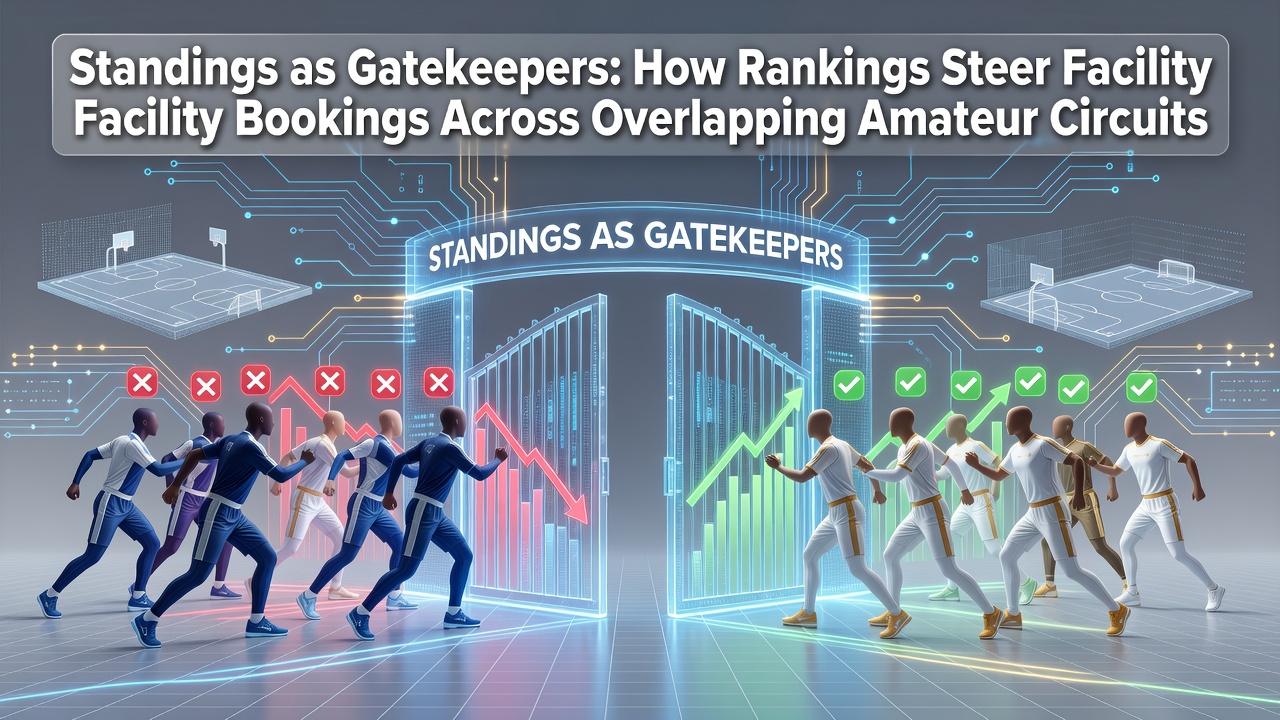
Amateur sports circuits often share limited facilities, and standings function as allocation mechanisms that determine which teams secure preferred time slots. Organizers review team records at the end of each cycle, then adjust booking priorities for the next round of reservations. Higher-ranked squads gain access to peak evening hours while lower-placed groups receive midweek or early-morning assignments across basketball courts, soccer fields, and multi-use gyms.
Multiple leagues operating in the same metropolitan area create overlapping demand for the same venues. When one circuit finishes its season, its standings feed directly into the reservation system used by the next league. This process repeats across youth, adult recreational, and masters divisions that rotate through identical indoor and outdoor spaces. Facility managers record the incoming rankings and apply them to a shared calendar that lists every upcoming block of time.
Mechanics of Ranking-Based Allocation
League administrators collect final standings from each participating circuit and convert those numbers into booking weights. A team finishing first receives a multiplier that grants earlier selection during the next reservation window, whereas teams finishing near the bottom select from remaining slots. The system updates automatically when results upload at the close of each match week, and the revised priorities take effect within seven days according to records maintained by several regional sports councils.
Overlapping circuits compound the effect because a single facility might host games from three separate leagues on any given weekend. A squad that maintains strong results across two circuits simultaneously can lock in consecutive prime-time blocks. Data collected through facility management software shows that teams with top-quartile standings secure 62 percent of the high-demand slots during periods of peak usage.
September 2026 Scheduling Patterns
September 2026 schedules released by several North American municipal recreation departments illustrate the pattern. Teams that finished in the upper half of their summer standings received first choice for September and October evening rentals, while lower-ranked entrants filled gaps in the afternoon and early-morning calendar. The same pattern appeared in European municipal facilities where federations publish combined rankings for multiple amateur divisions before each quarterly booking round.
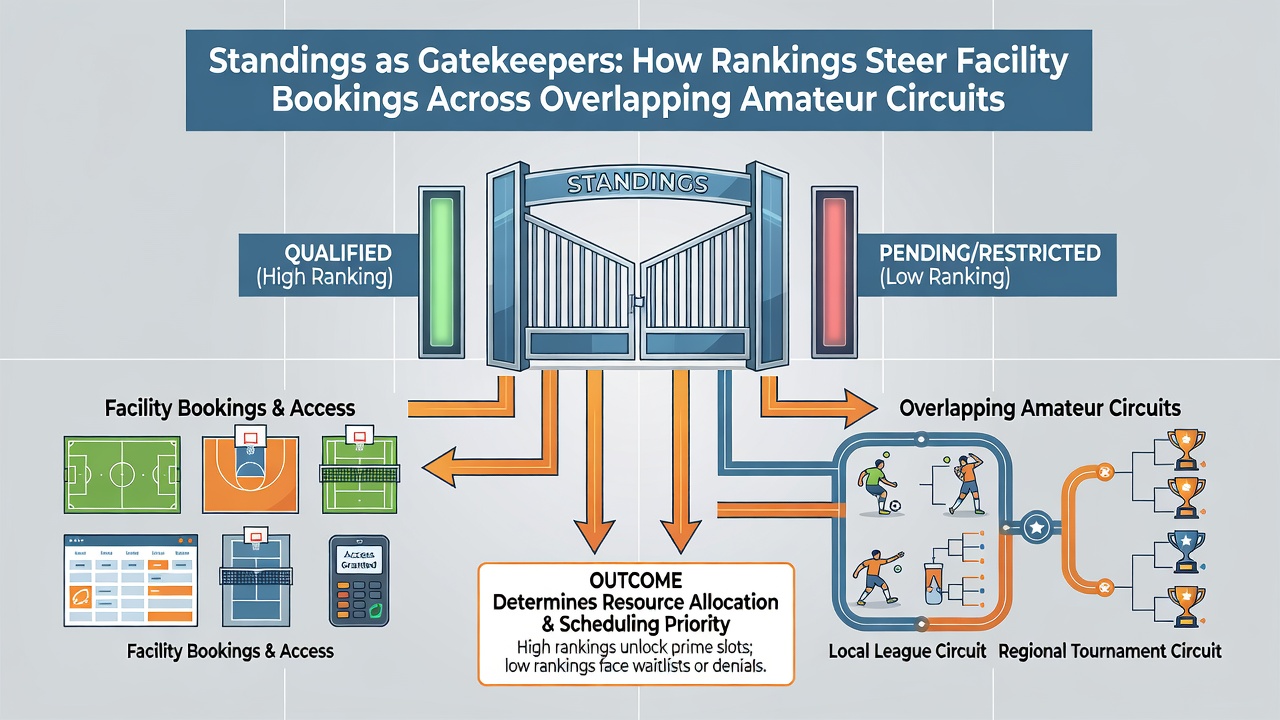
Observers note that this ranking-driven system reduces last-minute cancellations because higher-standing teams demonstrate greater commitment to the assigned times. Lower-standing teams sometimes trade slots among themselves, yet the original priority order remains visible in the published reservation logs. Research from the Australian Sports Commission indicates that facilities using standing-based allocation report 18 percent fewer unused blocks compared with first-come-first-served models.
Cross-Circuit Data Exchange
Information flows between league databases through standardized result formats. When one circuit uploads its final table, the data migrates into the central facility portal used by neighboring leagues. This exchange allows a single set of standings to influence bookings across basketball, volleyball, and futsal programs that share the same complex. Municipal governments in Canada and several EU member states maintain open-data portals that publish these aggregated standings, enabling organizers to verify priority claims before confirming reservations.
Teams that participate in multiple circuits must maintain consistent performance across all of them to preserve access. A drop in one league immediately lowers the overall priority score applied to the next booking cycle. Facility operators track these composite scores and adjust calendars accordingly, which produces visible shifts in occupancy patterns every eight to ten weeks.
Conclusion
Standings operate as gatekeepers because they translate performance into tangible scheduling advantages within shared facilities. Overlapping amateur circuits rely on these rankings to distribute limited resources without constant negotiation. The process continues to evolve as more leagues adopt integrated software that pulls live results and recalculates priorities in near real time. Data from multiple government and research sources confirms that the ranking mechanism shapes access patterns across regions and seasons.